
Tiny-Home Kitchen Appliances That Fit and Last
 Kaushik Kyada
July 28, 2026
7 min read
Kaushik Kyada
July 28, 2026
7 min read
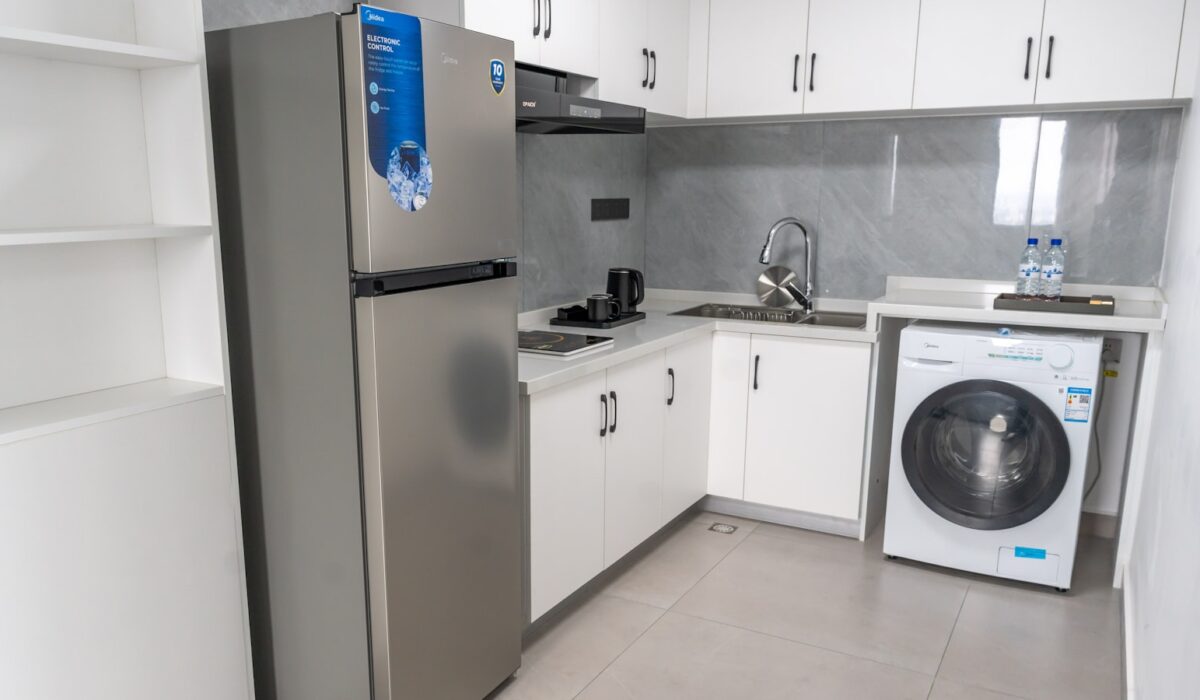
A tiny kitchen forces real choices about the fridge, cooktop, and oven long before you cook your first meal in it. The appliances that actually work are the ones that fit the cabinet opening, fit the electrical panel, and keep running for years without a service call to a shop two towns over. This guide covers the specific numbers that separate an appliance that fits and lasts from one that trips a breaker in week one, and the exact ratings to check on the box before you pay.

Size the electrical panel before you size the fridge
Most tiny homes run on 30-amp or 50-amp shore power, or on a battery and solar setup with a hard ceiling on continuous draw. Either way the kitchen has far less headroom than a standard house, so the first spec that matters is not the appliance at all, it is the circuit feeding it. The National Electrical Code section 210.11(C)(1) still requires dedicated 20 amperes of 120-volt small-appliance branch circuit to serve kitchen countertop receptacles in a dwelling, a wiring rule tiny-home builders have to plan around rather than skip.
Here is why that number governs everything else. A 20-amp circuit at 120 volts can carry about 1,920 watts, and the safe continuous figure is 80 percent of that, roughly 1,536 watts. Once you add up the nameplate wattage of everything that might run at the same moment, you can see whether your kitchen is buildable on the power you have. A single-burner induction unit alone can eat most of one circuit, which is exactly why the wattage of each appliance, not its footprint, is the real constraint in a space this small.
The refrigerator: buy by cubic feet and the yellow label
Refrigerators are the one appliance that runs 24 hours a day, so a small efficiency difference compounds into real money and, off-grid, into real battery capacity. Shop by total interior volume first. ENERGY STAR classifies a compact refrigerator or refrigerator-freezer as any unit under 7.75 cubic feet of total volume, and to earn certification a compact unit has to use at least 10 percent less measured energy than the minimum federal standard allows. That certification is the cleanest signal that a small fridge was engineered for efficiency rather than just shrunk down.
For a full-time tiny home, most people land between 4 and 7 cubic feet, which holds a week of groceries for one or two people. Read the yellow EnergyGuide label for the estimated annual kilowatt-hours, because two fridges of identical size can differ by 100 kWh or more a year. On battery power, a model rated near 200 kWh a year draws roughly 550 watt-hours a day, a load your battery bank must cover through every cloudy stretch, so treat the label number as a design input.

Cooktop: a plug-in induction burner instead of a hardwired range
A hardwired 240-volt range is often the wrong fit for a tiny home, both because it demands a heavy circuit and because it fixes a bulky box in place. A portable induction burner is the common alternative. A representative single-burner model, the Avanti IH1800L1B-IS, is rated at 1800 watts on a standard 120-volt, 15-amp household circuit, with a temperature range of 140°F to 460°F. That means it plugs into an ordinary outlet, boils water fast, and stows in a drawer when the counter is needed for prep.
The tradeoff is right there in the wattage. At 1,800 watts, one burner nearly fills a 15-amp circuit and takes a large bite out of a 20-amp one, so running two induction units at once usually means putting them on separate circuits. Induction also demands magnetic cookware: cast iron and most stainless work, while aluminum and copper do not. Test a pan with a fridge magnet before you assume the set you own will heat. For an oven, a countertop convection or air-fry unit in the 1,200 to 1,500 watt range covers most baking and roasting, drawing power only while the element is cycling.
Dishes: a compact dishwasher versus washing by hand
A dishwasher is optional in a tiny home, but the efficient models make a stronger case than most people expect. ENERGY STAR defines a compact dishwasher as one holding fewer than 8 place settings plus 6 serving pieces, and to qualify such a model must use no more than 2.0 gallons per cycle and no more than 155 kWh a year. Two gallons is often less water than a careful hand-wash of the same load, and far less than a running tap.
If you have the cabinet space and want more capacity, it helps to know the full-size benchmark too: an ENERGY STAR certified standard dishwasher must use no more than 240 kWh/year and no more than 3.2 gallons of water per cycle. Comparing the two, the compact unit saves water on every wash and roughly a third of the annual electricity, at the cost of fewer dishes per run. For a one or two person household running the machine once a day, the compact figures usually win.
A worked example: a 24-foot home on 30-amp service
Numbers land better against a real layout, so picture a common one. You have a 24-foot tiny house on wheels wired to a single 30-amp, 120-volt shore power pedestal, which gives you about 3,600 watts total for the entire home, not just the kitchen.
You install a 5.5 cubic foot ENERGY STAR fridge that pulls about 90 watts while its compressor runs, a single 1,800-watt induction burner, and a compact dishwasher rated near 155 kWh a year. Cooking dinner, the burner and fridge together draw close to 1,900 watts, which fits comfortably. The rule you live by is sequence, not simultaneity: you do not run the induction burner, the electric kettle, and the water heater in the same minute, because any two of those together can push past what the pedestal will hold.
No appliance in that kitchen is exotic. What makes it work is that each load is known and the high-draw items take turns instead of stacking. That is the discipline of a tiny kitchen: not owning less, but running one heavy appliance at a time.
When it goes wrong: the breaker trips mid-meal
The most common failure is not a dead appliance, it is a breaker that trips the moment two big loads overlap, usually with a pan half-cooked. Work through it in order:
- Shed the load before you reset. Switch off the induction burner and anything else drawing heavily, then reset the breaker. Resetting into the same overload just trips it again and stresses the panel.
- Add up the nameplate watts of what was running. If two items together exceeded the circuit, the fix is scheduling, not a new appliance.
- Check whether the countertop outlets share one circuit. If the kettle and the toaster are on the same 20-amp line, move one to a different circuit or simply do not run them together.
- Feel the plug and cord. A warm plug or a scorched smell points to a loose connection or an overloaded extension cord, which is a fire risk and needs an electrician, not another reset.
- If a single appliance trips a healthy circuit by itself, that appliance likely has an internal fault. Stop using it and test it on a known-good outlet before you blame the panel.
An appliance that fits and lasts is one you chose with the circuit, the cabinet, and the yellow label all in view at once. Get those three numbers right before you buy, and the kitchen mostly takes care of itself.
Related guides
Frequently asked questions
Can I run a normal kitchen on 30-amp shore power?
Yes, with sequencing. A 30-amp, 120-volt pedestal gives you about 3,600 watts for the whole home. A compact fridge, a single induction burner, lights, and a laptop fit inside that easily. The trouble comes when two heavy loads overlap, so the habit that keeps a 30-amp kitchen working is running the induction burner, water heater, and kettle one at a time rather than together.
Is induction actually better than a small propane cooktop in a tiny home?
It depends on your power source. Induction is efficient, produces no combustion moisture or fumes indoors, and needs no fuel storage, but it leans hard on your electrical capacity at 1,800 watts a burner. Propane keeps cooking during a power outage and does not touch your amp budget, at the cost of a fuel line, ventilation, and the humidity that open flames add to a small sealed space. Off-grid homes with modest battery banks often keep propane for exactly the outage reason.
What size refrigerator do two people need in a tiny home?
For two people cooking most meals at home, a 5 to 7 cubic foot fridge is the usual sweet spot: large enough for a week of groceries, small enough to stay under the 7.75 cubic foot compact ceiling and its efficiency rules. If you shop every few days or eat out often, a 4 cubic foot unit can work and draws even less power. Match the interior volume to your real shopping rhythm, then pick the lowest annual kilowatt-hour figure in that size.
Kaushik Kyada
Keep reading

Choosing Low-Energy Appliances Without Overspending
A grounded buyer’s guide to refrigerators, induction cooktops, washing machines and small kitchen tools for tiny homes.

Compact Hot Water: Tankless, Tank, and What Actually Fits
How to choose between tankless, small tanks, and on-demand systems for a tiny home, without the marketing fog.
Insulation Choices That Pay Off Slowly and Forever
A grounded comparison of small-home insulation options, fiberglass, mineral wool, foam, and sheep’s wool, without the moralizing.